
How to Choose the Right Railway Wagon Axle?
Choosing the right Railway Wagon Axle is a safety decision, not merely a purchasing task. The axle carries repeated loads, absorbs track irregularities, and transfers braking forces through the wheelset. A small design mistake can become a large maintenance problem.
Dr. Yukio Ishida, a respected railway wheel–rail researcher, expresses the central engineering concern this way: “Reliable wheel–rail contact is the foundation of safe railway operation.” His statement reminds engineers to examine the complete system, not the axle alone. Load capacity, axle diameter, steel grade, heat treatment, fatigue strength, and wheel-seat design must work together.
Start with the wagon’s maximum gross weight and expected service conditions. A heavy ore wagon needs different margins from a low-load covered wagon. Consider speed, curve frequency, axlebox arrangement, braking cycles, climate, and track quality. Salt air can accelerate corrosion. Poor track alignment can increase impact loads.
Standards matter. So does evidence.
Select an axle that matches applicable railway specifications, certified manufacturing processes, and documented inspection procedures. Ultrasonic testing, dimensional checks, material traceability, and surface-finish control should be part of the evaluation. Ask suppliers for test records, not attractive promises.
The most overlooked detail may be maintenance access. An axle that is difficult to inspect can create hidden risk during service. Field experience also matters. A theoretically strong axle may perform poorly when wheel fits, lubrication, or handling practices are inconsistent.
There is no universal “best” Railway Wagon Axle. The correct choice depends on verified operating data, conservative engineering judgment, and honest review of past failures. Sometimes, the first specification needs questioning. That is healthy engineering.
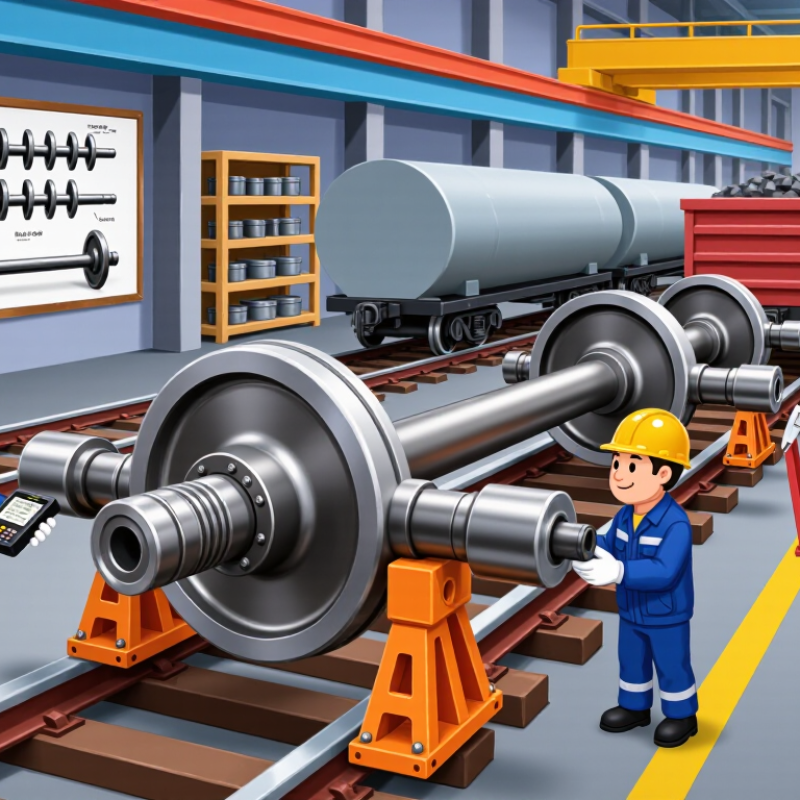
Define the Railway Wagon’s Operating Requirements
How to Choose the Right Railway Wagon Axle?
Define the Railway Wagon’s Operating Requirements
Axle selection begins with the wagon’s real operating profile, not a catalogue dimension. Record payload, tare weight, speed, route length, curve radius, braking cycles, and loading frequency. A 22.5-tonne axle-load class is widely used on standard-gauge freight routes, according to UIC Railway Statistics 2024. However, that figure is only a starting point. Seasonal temperature changes, track quality, and wheel-flat risks can alter the required axle design.
Eurostat’s Rail Transport Statistics 2024 recorded about 375 billion tonne-kilometres of EU rail freight in 2023. This volume shows why duty cycles deserve careful attention. A wagon running short regional trips faces different thermal stresses than one hauling heavy cargo across long corridors. Engineers should calculate vertical loads, lateral forces, fatigue life, bearing loads, and braking heat under the worst credible combination. Check maintenance intervals, inspection access, and corrosion exposure too. Small omissions become expensive later.
Do not select an axle from static load alone. Field measurements can reveal uneven loading, repeated impact events, or wheel unloading that design assumptions miss. Standards such as EN 13103-1 support axle calculations, but they cannot replace route-specific evidence. A practical review should compare measured loads with the design model. The model may be wrong. That possibility deserves attention. Axle material, diameter, hollow or solid construction, and ultrasonic inspection requirements should then match the wagon’s operating environment and approval framework.
Compare Axle Types, Materials, and Load Ratings
How to Choose the Right Railway Wagon Axle?
Axle selection begins with load, speed, and track conditions. A freight axle may carry 20, 22.5, or 25 tonnes per axle, depending on the network. UIC Code 700 identifies 22.5 tonnes as a widely used reference for heavy freight routes. Higher ratings can increase capacity, but they also raise wheel, bearing, and track stress. A spreadsheet alone can mislead.
Solid axles suit conventional wagons and offer proven fatigue resistance. Hollow axles reduce unsprung mass, though manufacturing quality becomes more critical. Carbon steel remains common because it balances strength, machinability, and cost. Microalloyed steel can improve fatigue performance.
EN 13261 specifies requirements for railway axle materials, testing, and mechanical properties. Check the actual grade, not only the supplier’s headline strength. The International Union of Railways also stresses fatigue assessment under repeated loading. Small defects may grow after millions of wheel rotations.
Tips:
- Match the axle rating to the wagon’s gross load, not its average load.
- Confirm braking forces, curves, and winter temperatures.
- Compare ultrasonic inspection records and heat-treatment certificates.
- Ask whether the design follows EN 13261, AAR M-101, or the applicable national standard.
- Leave a safety margin, but avoid excessive steel. It adds weight and may reduce payload.
- I would also review maintenance data from similar routes. That step is often skipped.
Evaluate Wheelset Compatibility and Safety Standards
Choosing a railway wagon axle starts with wheelset compatibility, not only load capacity. Check axle journals, wheel-seat dimensions, wheel profile, brake equipment, and bogie design against the wagon’s approved configuration. A small mismatch can create uneven contact, heat marks, or unstable running.
EN 13260 defines wheelset requirements, while EN 13261 covers axle product specifications and EN 13262 addresses wheels. These standards support traceable material, dimensional, and fatigue checks. The European Union Agency for Railways reported 1,517 significant railway accidents and 808 fatalities in 2022. Most involved trespassers or level crossings, yet reliable rolling stock remains essential to reducing operational risk.
Ask for documented ultrasonic inspection, dimensional records, and fatigue-test evidence. Confirm the axle material and design load match the wagon’s gross weight, speed, and braking forces. A wheelset that fits mechanically may still fail operationally. Inspectors should also review corrosion, press-fit condition, and bearing temperature history. In practice, maintenance records can be incomplete. That deserves scrutiny.
The ERA report also recorded 1,319 serious injuries in 2022, showing why safety decisions need evidence rather than assumptions. Select components with clear serial identification and controlled manufacturing records. Independent conformity assessment adds confidence, especially when replacing an older axle design. Check twice.
How to Choose the Right Railway Wagon Axle?
Compare the wagon’s nominal axle-load class with the axle, wheel, bearing, bogie, and route requirements. The values below show common freight-rail axle-load classes and their equivalent static loads in kilonewtons.
Compatibility should be verified against the applicable technical requirements, including wheel geometry, axle design, braking loads, bearing capacity, gauge clearance, and route axle-load limits. Wheel and axle selection is commonly assessed with reference to EN 13262, EN 13103-1, EN 15528, and relevant UIC technical specifications.
Check Manufacturing Quality, Maintenance, and Service Life
How to Choose the Right Railway Wagon Axle?
Check Manufacturing Quality, Maintenance, and Service Life
A reliable railway wagon axle begins with controlled manufacturing, not an attractive price. Check material certificates, forging records, heat-treatment results, and production traceability. The axle should meet applicable railway standards and approved dimensional tolerances. Pay close attention to wheel seats, journal surfaces, fillets, and key transition areas. These locations experience repeated stress during loaded operation.
Visual inspection is necessary, but it is not enough. Ultrasonic testing can reveal internal flaws, while magnetic particle testing may identify surface cracks. Measure journal diameter and roundness with calibrated equipment. A clean-looking axle can still contain hidden damage.
I have seen small surface marks become expensive failures when inspections were delayed. That experience also shows a weakness in simple checklists: they may miss operating history, previous repairs, or unusual loading.
Maintenance records should show inspections, wheelset changes, lubrication checks, and detected defects. Monitor bearing temperature, vibration, mileage, and impact readings where available. Service life depends on load cycles, track conditions, corrosion, and maintenance quality, not only calendar years. Replace an axle when measurements exceed approved limits, even if it still appears usable. Do not guess here.
Tips: Keep full traceability from forging to service. Use calibrated tools. Inspect after abnormal impacts. Compare measurements over time. Review the maintenance plan when operating conditions change. An experienced inspector should investigate repeated defects instead of simply replacing parts.
Select the Axle Based on Cost, Availability, and Performance
How to Choose the Right Railway Wagon Axle?
Select the Axle Based on Cost, Availability, and Performance
Choosing the right railway wagon axle requires more than comparing purchase prices. Start with the wagon’s axle load, operating speed, track gauge, braking system, and service environment. A freight wagon carrying dense bulk material may need a different fatigue margin than a light-duty wagon. Review certified drawings, material traceability, heat-treatment records, and dimensional tolerances before approval. Details matter.
Cost should include machining, inspection, transport, installation, and expected maintenance. A low-priced axle may create higher expenses if wheel-seat wear or delayed delivery interrupts fleet availability. Ask suppliers for realistic lead times and replacement capacity, not optimistic estimates. Confirm whether spare axles, compatible wheels, and repair expertise are accessible near the operating depot. Availability is practical resilience. Still, cost models can be imperfect; actual failures and downtime rarely follow spreadsheet assumptions.
Performance depends on fatigue strength, impact resistance, corrosion protection, and stable behavior under repeated loading. Use applicable railway standards and independent inspection methods to verify these properties. Ultrasonic testing can reveal internal flaws, while surface checks can identify cracks around wheel seats and journal areas. Ask for evidence from comparable duty cycles, but examine the differences carefully. Temperature, axle alignment, lubrication, and overloading can change results. Do not select the strongest axle automatically. An unnecessarily heavy design may raise unsprung mass and operating cost. Record each assumption and revisit it after inspections and service data.
| Evaluation Dimension | Solid Forged Steel Axle | Hollow Forged Steel Axle | Built-Up or Legacy Axle Assembly |
|---|---|---|---|
| Typical railway use | Standard choice for general freight wagons, high-load applications, and widely used wagon platforms. | Used where axle mass reduction is important and the vehicle design, manufacturing process, and inspection system support a hollow section. | Found mainly in older or specialized vehicle designs; suitability depends heavily on the existing bogie and maintenance system. |
| Initial purchase cost | Low to Medium Acts as the practical cost baseline because production routes, tooling, and supply chains are widely established. | Medium to High Requires more complex forging, machining, heat treatment control, and inspection than a comparable solid axle. | Potentially Low for Replacement-in-Kind May become expensive if special parts, legacy drawings, or limited production tooling are required. |
| Procurement availability | High Common specifications and established manufacturing capacity generally support shorter sourcing cycles. | Medium Availability is more dependent on qualified suppliers and the required approval system. | Low to Medium Availability can be limited by vehicle age, obsolete designs, or a small number of qualified sources. |
| Axle mass | Higher than an equivalent hollow design, but the mass is predictable and normally acceptable for freight-wagon applications. | Lower than an equivalent solid axle when properly optimized; the actual saving depends on axle load, geometry, and fatigue requirements. | Varies widely according to the design; mass benefits should not be assumed without verified drawings and measurements. |
| Fatigue performance | Well Established Provides a robust fatigue solution when material quality, heat treatment, surface finish, and dimensional tolerances meet the applicable standard. | High When Correctly Designed Requires strict control of internal geometry, stress concentration, residual stress, and manufacturing quality. | Design Dependent Connections, joints, and local stress concentrations may require additional assessment and inspection. |
| Manufacturing complexity | Moderate Forging, heat treatment, machining, dimensional inspection, and non-destructive testing are standard production activities. | High Internal surfaces and transitions require tighter process control and specialized inspection capability. | High Assembly tolerances, joint condition, and replacement-part compatibility add complexity. |
| Inspection requirements | Visual and dimensional checks, material traceability, and non-destructive testing such as ultrasonic inspection are typically required by the governing railway specification. | Requires the same basic controls as a solid axle plus reliable inspection of the bore, internal transitions, and other hollow-section surfaces. | Requires inspection of both individual components and assembled interfaces, including fit, alignment, and joint condition. |
| Maintenance and replacement | Straightforward Replacement procedures and compatible wheelset components are generally easier to source and manage. | More Specialized Damage assessment and replacement may require personnel and equipment familiar with hollow axle construction. | More Demanding Maintenance may involve specialized parts, legacy procedures, and closer control of assembly condition. |
| Supply-chain risk | Low Usually the safest option where delivery certainty and replacement availability are priorities. | Medium Supplier qualification, specialized tooling, and lower production volumes can increase lead-time risk. | High Design obsolescence and limited manufacturing sources can affect long-term support. |
| Best choice when cost is the main priority | Preferred option. Select a standardized solid forged axle that meets the required axle load, wheelset geometry, material, and fatigue criteria. | Consider only when reduced mass creates a measurable operational benefit that offsets the higher purchase and inspection cost. | Use only when replacing an existing approved assembly is less costly than redesigning and qualifying a modern axle. |
| Best choice when availability is the main priority | Preferred option. A widely specified solid axle normally provides the broadest supplier and replacement-part network. | Confirm qualified suppliers, production capacity, approval documentation, and spare-part support before selecting this design. | Confirm long-term availability of every component before committing to continued use. |
| Best choice when performance is the main priority | Best for proven durability, high axle loads, and uncomplicated fleet maintenance. | Preferred only for a validated lightweight design. It can reduce unsprung mass, but performance depends on detailed design verification and inspection quality. | Suitable only where the existing design has a documented service history and meets current safety and fatigue requirements. |
| Key selection checks before ordering | Verify axle load, wheel-seat dimensions, bearing-seat dimensions, material grade, heat-treatment condition, fatigue requirements, and applicable railway standard. | Verify all solid-axle checks plus bore geometry, minimum wall thickness, internal inspection method, fatigue analysis, and manufacturing approval. | Verify original design records, component compatibility, joint condition, inspection procedure, and continued regulatory acceptance. |
| Overall recommendation for a new freight-wagon project | Default selection. Offers the best balance of purchase cost, availability, proven performance, and maintainability for most freight-wagon applications. | Use when weight reduction has a quantified lifecycle benefit and the project can support specialized design, manufacturing, and inspection controls. | Generally not preferred for a new design unless there is a specific technical or fleet-standard reason. |
Article Source:
We Meet Our Clients Needs.
Meeting the diverse needs of our clients, we have complete machining facilities for everything from single part prototypes to large quantity production. Our small size is one of our biggest assets. It allows us to control costs and maintain the highest of standards.
Quality orientated and delivery always on time or earlier than originally promised.
Strongly recommend MSD.