
How to Choose the Best HVLS Motors for Global Buyers?
Selecting the right Hvls Motors is not a simple price comparison. Global buyers must examine airflow, voltage, duty cycle, control compatibility, and service access. A motor that performs well in a Texas warehouse may struggle in a humid coastal plant. Conditions matter.
Carey Smith, founder of Big Ass Fans, has said, “We’re not in the fan business; we’re in the business of making people comfortable.” That perspective remains useful when evaluating HVLS Motors. The motor should support measurable comfort, stable air movement, and dependable operation. It should not merely look efficient on a brochure.
A practical evaluation begins with the building itself. Measure ceiling height, floor area, ambient temperature, dust exposure, and operating hours. Check whether the motor supports the buyer’s local power supply, such as 380–415 V or 460 V systems. Ask for verified efficiency data, acoustic ratings, thermal protection details, and expected maintenance intervals. Small details matter. A sealed bearing can reduce service interruptions. A compatible variable-frequency drive can improve speed control.
Global procurement also requires clear documentation. Confirm certifications, spare-parts availability, warranty terms, and response times before placing an order. Some suppliers provide impressive laboratory figures but limited field support. That weakness can become expensive.
The “best” motor is therefore conditional. It depends on the facility, climate, controls, and maintenance team. Even experienced buyers can misjudge these factors. A careful comparison, supported by test data and site measurements, offers a safer path to reliable HVLS performance.
Define HVLS Motors and Their Role in Large-Scale Air Movement
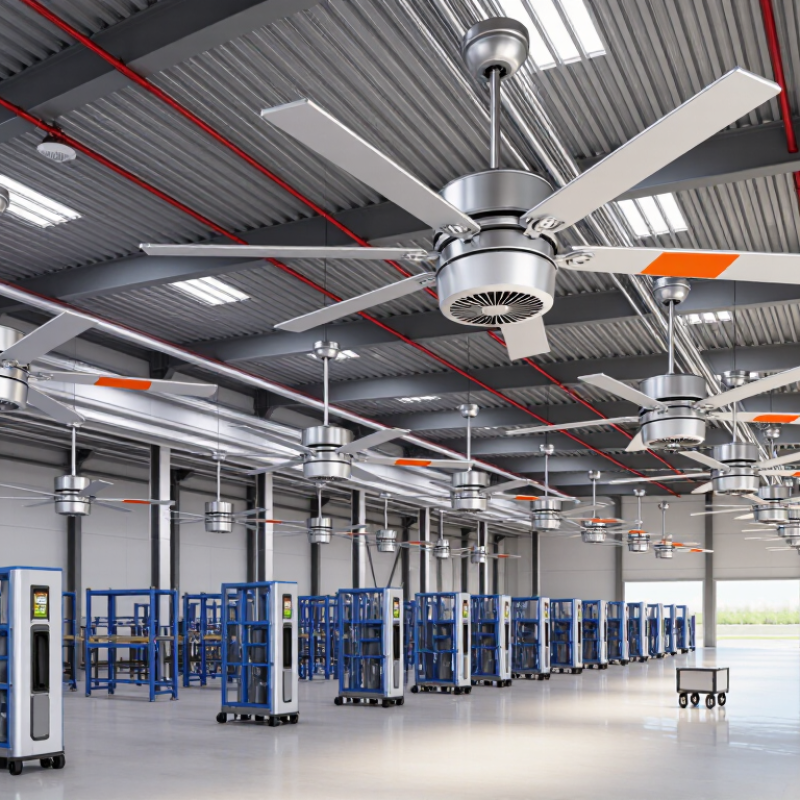
HVLS motors drive High Volume, Low Speed fans used for large-area air movement. These motors rotate wide blades at a controlled, low speed. The result is a broad, gentle airflow rather than a sharp blast. This design helps move warm ceiling air downward and spread cooler air across occupied areas. The motor provides steady torque, efficient operation, and reliable control during long working hours.
In warehouses, workshops, sports halls, and agricultural buildings, air can separate into hot and cool layers. An HVLS fan reduces this stratification through continuous circulation. Workers may feel more comfortable near floor level. HVAC systems may also operate with less effort when airflow is distributed properly. However, fan performance depends on ceiling height, blade diameter, building layout, and obstruction levels. Bigger is not always better.
Global buyers should examine motor duty ratings, voltage, frequency, thermal protection, ingress protection, and control compatibility. A motor designed for 50 Hz power may require different settings in a 60 Hz facility. Local service access matters too. Practical assessments often reveal an overlooked issue: a strong motor cannot correct poor installation. Misaligned mounting, unstable power, or incorrect control settings can reduce airflow and increase noise. Specifications deserve careful review, but real site conditions deserve equal attention. That limitation matters.
Compare Motor Types, Drive Systems, and Performance Characteristics
Choosing the best HVLS motor starts with the building, not the catalogue. In warehouses, workshops, and livestock areas, motor selection affects airflow, noise, maintenance, and energy use. Permanent magnet motors usually deliver strong efficiency at low speeds. They also provide compact designs and precise control. Induction motors remain practical where ruggedness, familiar servicing, and lower initial cost matter. However, their efficiency may drop during partial-load operation.
Drive systems deserve equal attention. Variable frequency drives allow gradual starts, speed adjustment, and better airflow control across changing seasons. Integrated electronic drives can simplify installation and reduce external wiring. Yet, they may require trained technicians and careful protection from dust, heat, or electrical surges. I have seen projects focus on rated power while overlooking voltage stability. That mistake can produce unstable performance and unexpected downtime. Check rated voltage, frequency, overload capacity, braking behavior, and control compatibility before ordering. Compare measured efficiency at common operating speeds, not only the maximum rating.
Tips: Ask for performance curves, noise data, service intervals, and test conditions. Confirm enclosure protection for humid or dusty spaces. Keep spare sensors and key drive components available. A cheaper motor can become expensive when local support is limited. Also, leave room for honest review: projected savings are estimates, and real airflow depends on ceiling height, obstructions, and installation quality.
How to Choose the Best HVLS Motors for Global Buyers? - Compare Motor Types, Drive Systems, and Performance Characteristics
A practical comparison of commonly used motor and drive technologies for high-volume, low-speed ceiling fans.
| Motor / Drive Option | Typical Power Range | Typical Speed Range | Approximate Motor Efficiency | Drive System | Main Strengths | Key Limitations / Buyer Considerations |
|---|---|---|---|---|---|---|
| Permanent-Magnet Synchronous Motor (PMSM) | 0.75–5.5 kW | 50–300 rpm at the fan rotor, depending on design | Approximately 88–95% in the rated operating region | Electronic commutation using an inverter or variable-frequency drive | High efficiency, strong low-speed torque, compact direct-drive layouts, and low routine maintenance | Higher initial cost; magnets and electronic controls require careful thermal design and qualified servicing |
| Brushless DC Motor (BLDC) | 0.2–3.0 kW | 50–400 rpm at the fan rotor, depending on pole count and control settings | Approximately 85–93% in suitable operating conditions | Electronic controller with Hall sensors or sensorless commutation | Efficient variable-speed operation, quiet performance, and good suitability for small and medium HVLS fans | Controller quality varies widely; electronic components may require protection from heat, dust, and voltage disturbances |
| Three-Phase Induction Motor with VFD | 1.1–7.5 kW | Approximately 50–300 rpm at the fan rotor; motor speed is controlled through the VFD and transmission | Approximately 82–92% for the motor; total system efficiency is lower after drive and transmission losses | Variable-frequency drive with programmable acceleration, deceleration, and speed limits | Widely available, rugged, easy to source globally, and suitable for demanding industrial environments | Usually larger and heavier; may require a gearbox or belt system, and low-speed cooling and torque must be checked carefully |
| Single-Phase Induction Motor with Electronic Speed Control | 0.2–1.5 kW | Approximately 80–250 rpm at the fan rotor | Approximately 70–85%, depending on motor design and controller | Phase-angle, capacitor-based, or compact inverter control | Compatible with common single-phase power supplies and generally economical for smaller installations | Lower efficiency and weaker speed regulation than modern three-phase or permanent-magnet systems; not ideal for very large fans |
| Geared Motor System | 1.1–7.5 kW motor input | Motor commonly operates near 900–1,800 rpm; gearbox reduces output to approximately 50–300 rpm | Approximately 75–90% for the combined motor and gearbox system | Usually an induction motor with a VFD; gearbox may be helical, planetary, or another industrial configuration | High starting torque, familiar service procedures, and broad availability of replacement motors and drives | Gear wear, oil or grease maintenance, acoustic noise, vibration, and additional mechanical losses increase lifecycle requirements |
| Direct-Drive Motor | 0.75–5.5 kW | Approximately 50–300 rpm without a gearbox | Approximately 85–95%, depending on motor technology and load point | Integrated inverter, VFD, or other closed-loop electronic controller | Fewer mechanical parts, reduced maintenance, lower transmission noise, and efficient operation at low speed | Requires a larger low-speed motor and reliable electronics; replacement parts may need to be sourced as a matched system |
Direct-drive PMSM and BLDC systems generally deliver strong efficiency at variable, low-speed operating points when correctly matched to the fan load.
Three-phase induction motors with standardized VFDs are often easier to source and maintain across multiple countries.
BLDC or single-phase solutions can be practical where fan diameter, power demand, and available electrical capacity are limited.
Note: The figures are representative engineering ranges rather than guaranteed product specifications. Actual performance depends on fan diameter, blade design, air density, operating speed, duty cycle, ambient temperature, voltage, control method, and transmission losses. Buyers should verify the complete fan system using certified test data and the applicable electrical and safety standards for the destination market.
Assess Key Specifications for Different Building and Climate Conditions
Selecting an HVLS motor starts with the building, not the catalog. A warehouse with 12-meter ceilings needs steady torque and broad airflow coverage. A retail space may require quieter operation and smoother speed changes. Measure ceiling height, floor area, occupancy, and existing ventilation before comparing motor ratings. Bigger is not always better.
Climate conditions can change motor performance significantly. In humid or coastal buildings, choose suitable enclosure protection and corrosion-resistant components. Dusty workshops need sealed designs that limit particle entry. For cold regions, check the rated starting temperature and lubricant performance. Hot climates require careful review of ambient temperature limits, insulation class, and thermal protection. These details look technical. They prevent expensive surprises.
Voltage, frequency, current draw, and controller compatibility deserve equal attention. Confirm the motor can operate reliably with the site’s electrical supply. Ask for efficiency data across the expected speed range, not only at maximum output. During field projects, installers often focus on peak torque and overlook low-speed stability. That can create uneven airflow near occupied areas. Service access also matters. A motor that is difficult to inspect may increase downtime. Keep maintenance records, but do not treat them as perfect evidence. Actual performance can change with dust, humidity, installation quality, and seasonal loads. A practical trial run under real building conditions is often more useful than a long specification sheet.
Evaluate Energy Efficiency, Durability, Controls, and Maintenance Needs
For global buyers, HVLS motor selection starts with measurable energy performance, not brochure promises. Compare rated power, operating speed, airflow coverage, and seasonal load data. A motor that runs efficiently at full speed may waste energy during mild weather. Ask for efficiency curves and standby consumption. Small differences matter in warehouses operating twelve hours daily. Request test conditions, because laboratory figures can change with voltage, temperature, and controller settings.
Durability depends on more than a sealed housing. Inspect bearing type, insulation class, corrosion protection, and expected service life. In humid or dusty buildings, ingress protection and coating quality deserve closer review. I would also check whether replacement parts remain available locally. That detail is easy to overlook. It can stop a fan for weeks. Controls should support soft starting, speed adjustment, fault codes, and building-system integration. Confirm compatibility with local voltage, frequency, and communication protocols. Manual override remains valuable when sensors fail.
Maintenance needs should be visible before purchase. Ask for lubrication intervals, inspection points, access clearance, and estimated technician hours. Clear manuals, wiring diagrams, and multilingual support improve reliability across regions. Remote monitoring can reveal rising current or vibration, but it is not magic. Sensors drift. Operators still need training and practical checks. Access matters. A lower-cost motor may look attractive, yet difficult access can increase lifetime expense. I would compare five-year energy and maintenance records, not only the initial quotation. Some projections will be imperfect because building usage changes. State those assumptions openly.
Select a Reliable HVLS Motor Supplier for Global Installation Requirements
Choosing an HVLS motor starts with the installation site, not a catalog image. A reliable supplier should explain torque, duty cycle, voltage range, cooling method, and expected service life. For a warehouse with dusty air and long operating hours, sealed bearings and stable thermal performance matter. Small details matter. Request measured data under realistic loads, not only attractive efficiency figures. An experienced supplier will discuss airflow targets, ceiling height, ambient temperature, and control compatibility before quoting.
Global projects add practical pressure. The motor may need different voltage options, communication interfaces, mounting dimensions, and documented safety testing. Choose a supplier that has supported installations in comparable climates and building types. Ask for wiring diagrams, inspection records, spare-parts plans, and remote troubleshooting procedures. Clear documents reduce delays when local technicians open the control cabinet. Ask for evidence. Test the supplier with specific questions about replacement parts, technical support, and response times.
Price deserves attention, but lifecycle cost deserves more. A cheaper motor can consume more power, run hotter, or require frequent service. Request warranty terms in writing, including exclusions for installation errors. This is where judgment becomes less comfortable. Technical teams sometimes accept incomplete data to meet a deadline. That decision may save days and create years of maintenance. Review factory quality controls, product traceability, production capacity, and after-sales training before approving the purchase. Field conditions differ. A dependable supplier remains available after delivery, when real installation problems appear.
How to Choose the Best HVLS Motors for Global Buyers?
Select a reliable HVLS motor supplier that can match the motor’s electrical design to the installation market. Grid frequency is a critical specification because motors must be designed for the local power system.
The chart shows the commonly used nominal grid frequency by market. North America generally uses 60 Hz, while most European and Asian markets use 50 Hz. Japan operates on both 50 Hz and 60 Hz depending on the region. Before global installation, confirm voltage, frequency, phase, motor efficiency, protection rating, control compatibility, and local certification with the supplier.
Reference: IEC 60038 standard nominal supply frequencies and regional power-system practice.
Article Source:
We Meet Our Clients Needs.
Meeting the diverse needs of our clients, we have complete machining facilities for everything from single part prototypes to large quantity production. Our small size is one of our biggest assets. It allows us to control costs and maintain the highest of standards.
Quality orientated and delivery always on time or earlier than originally promised.
Strongly recommend MSD.