
China Best Tile Bond Adhesive Supplier?

Choosing the China Best Tile Bond Adhesive Supplier requires more than comparing prices or colorful packaging. Tile Bond Adhesive affects bond strength, installation speed, water resistance, and long-term surface safety. A reliable supplier should show consistent factory production, clear technical data, and practical testing records.

Donato Pompo, CTC, CSI, CDT, a respected ceramic tile and stone consultant, states, “The tile installation is only as good as the substrate.” This principle remains important when evaluating Chinese manufacturers. A strong supplier should explain whether its adhesive meets EN 12004 or ISO 13007 requirements. It should also identify suitable classes, such as C1, C2, T, E, or S1. These details matter on concrete floors, cement boards, bathrooms, balconies, and exterior walls.

Real experience often reveals more than a brochure. Ask for batch numbers, laboratory reports, mixing instructions, and samples from recent production. Check the powder texture after opening the bag. It should look uniform, not visibly separated. Measure working time under realistic site conditions. Heat, humidity, uneven substrates, and rushed preparation can change results.

No adhesive fits every project.

That is where this comparison becomes imperfect. A supplier may offer excellent laboratory figures but provide weak technical support after shipment. Another may offer low prices while hiding inconsistent raw materials. The best decision balances certified performance, application guidance, production control, export experience, and honest communication. This guide examines leading Chinese suppliers through those practical standards, helping buyers identify dependable Tile Bond Adhesive for residential, commercial, and demanding renovation projects.
China Best Tile Bond Adhesive Supplier?

What Is Tile Bond Adhesive and Where Is It Used?

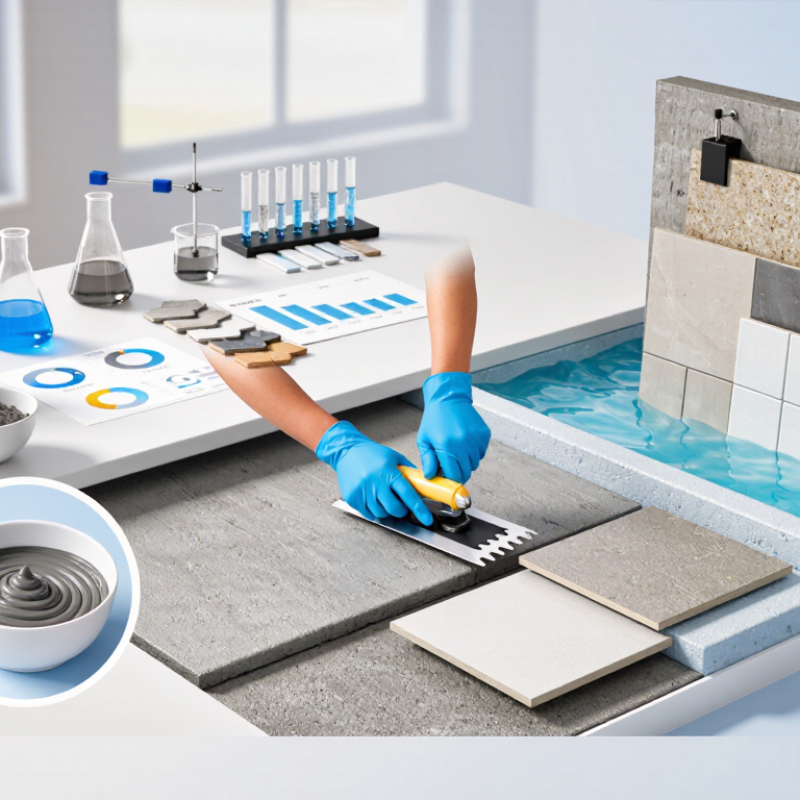
Tile bond adhesive is a cement-based or polymer-modified material that fixes tiles to prepared surfaces. It creates stronger contact than ordinary cement mortar in many applications. The adhesive is usually spread with a notched trowel. Tile backs are then pressed into the ridges before the material skins over.

It is used on concrete floors, cement boards, plastered walls, and some existing tile surfaces. Common projects include kitchens, bathrooms, balconies, commercial floors, and swimming-pool surroundings. Different tiles need different formulas. Porcelain tiles have low water absorption, so they often require improved adhesion. Large-format tiles also need careful coverage to reduce hollow spots.

Surface preparation decides much of the result. Dust, grease, loose paint, and standing water can weaken the bond. The substrate should be firm, reasonably flat, and compatible with the adhesive. In wet areas, waterproofing is still necessary. Adhesive alone is not a waterproof system. A practical mistake is adding extra water when the mix feels stiff. That may reduce strength and increase shrinkage. Follow the product data sheet and local building requirements. Open time, curing time, temperature, and joint movement all matter. I still find coverage difficult to judge by sight, especially beneath large tiles. Lifting a test tile can reveal empty areas before the installation becomes expensive to repair.

How to Evaluate a China-Based Tile Bond Adhesive Supplier

China Best Tile Bond Adhesive Supplier?

How to Evaluate a China-Based Tile Bond Adhesive Supplier

Market demand is expanding. Fortune Business Insights valued the global tile adhesive market at about USD 3.6 billion in 2023, with continued growth projected through 2032. Grand View Research also identifies construction activity and renovation as major demand drivers. These figures indicate opportunity, not proof of supplier quality.

Start with technical evidence. Ask for test reports based on ISO 13007 or EN 12004 requirements. Check tensile adhesion, open time, slip resistance, and curing performance. A reliable supplier should provide batch-specific records, not only a polished brochure. Request samples from the same production line used for commercial orders. Test them on concrete, ceramic, and porcelain surfaces.

Look closely at factory controls. Review raw-material inspection, moisture protection, mixing accuracy, and packaging strength. A site audit can reveal dusty storage rooms or inconsistent labeling. Those details matter. Ask how the supplier handles failed batches and customer complaints. Honest answers are more valuable than perfect claims.

I have seen samples perform well in a showroom but weaken after poor storage. That mistake is easy to repeat. Confirm shelf life, pallet protection, container loading, and transport conditions in writing. Compare quotations by cement content, polymer quality, testing frequency, and delivery reliability. The cheapest offer may exclude essential controls. A small pilot order, followed by independent laboratory testing, can expose weaknesses before a full shipment.

China Best Tile Bond Adhesive Supplier? - How to Evaluate a China-Based Tile Bond Adhesive Supplier

Evaluation Dimension Importance Relevant Data or Practical Benchmark What to Request or Check Suggested Scoring Method
Product Classification High Confirm whether the product is cementitious tile adhesive, dispersion adhesive, or reaction-resin adhesive. The intended application should match the adhesive class. Request the technical data sheet, product classification, recommended substrate, tile type, indoor or outdoor use, and wet-area limitations. 5: Clear classification and application limits
3: Partial information
1: Unclear product identity
Relevant Standard Compliance High For cementitious tile adhesives, EN 12004-1 commonly uses classifications such as C1 or C2, with additional designations including T, E, F, and S1/S2 where applicable. Check the test standard, laboratory report, certificate scope, product code, testing date, and whether the tested formulation matches the supplied product. 5: Relevant, traceable test evidence
3: Certificate supplied but limited traceability
1: Marketing claim only
Bond Strength High Review tensile adhesion values for the specific curing conditions, such as dry, water immersion, heat aging, or freeze-thaw exposure. Do not compare isolated values without test conditions. Ask for the complete test method, substrate type, tile type, curing period, test temperature, and minimum versus average results. 5: Results cover the intended use
3: Basic dry adhesion data only
1: No quantitative test data
Open Time and Adjustability Medium Open time and adjustment time should be stated in minutes under defined laboratory conditions. Actual working time changes with temperature, humidity, mixing, and substrate absorption. Request the stated open time, adjustment time, pot life where applicable, test temperature, and application thickness. 5: Clear values with conditions
3: General application guidance
1: No working-time information
Slip Resistance Medium For wall tile installations, review the product's slip classification or measured slip value where required by the applicable standard. Check test results for vertical application and confirm the data applies to the intended tile size and substrate. 5: Verified slip data for the use case
3: General claim with limited evidence
1: No slip information
Deformability and Flexibility High Flexible or deformable adhesive may be needed for large-format tiles, heated floors, exterior areas, or substrates subject to movement. S1 and S2 classifications indicate different deformability levels under EN 12004-1. Match the stated deformability classification to the project conditions, substrate movement, tile format, and environmental exposure. 5: Appropriate classification and evidence
3: Flexibility claimed without full data
1: Not suitable for the project
Raw Material and Formula Control High Consistent cement, graded aggregate, polymer, cellulose ether, and additive quality supports stable workability and bond performance. Formula changes can affect test results and production consistency. Request a controlled raw-material specification, incoming inspection procedure, batch formula control, and change-notification process. 5: Documented control system
3: Basic inspection only
1: No evidence of formula control
Factory and Batch Quality Control High A reliable supplier should be able to trace production batches, retain samples, control moisture, and perform routine checks for packaging, setting behavior, and adhesion-related properties. Request a sample quality-control report, batch number format, retained-sample policy, calibration records, and factory audit access. 5: Traceable and repeatable QC process
3: Some records available
1: No batch-level documentation
Packaging and Shelf Life High Dry powder adhesive must be protected from moisture. The label should state batch identification, net weight, production date, expiry or recommended use period, storage conditions, and mixing instructions. Inspect packaging samples, pallet protection, bag strength, storage requirements, shelf-life statement, and labeling compliance for the destination market. 5: Complete and consistent labeling
3: Minor information gaps
1: Poor moisture protection or traceability
Technical Support Medium Application guidance should cover water dosage, mixing time, maturation time, trowel selection, coverage, open time, curing, substrate preparation, and limitations. Evaluate the technical data sheet, safety data sheet, installation guide, response time, and ability to provide troubleshooting support. 5: Complete, usable technical support
3: Basic documents only
1: Sales information without installation guidance
Sample and Field Validation High Laboratory data should be supplemented by testing with the actual tile, substrate, climate, mixing equipment, and installation method. A small trial order reduces commercial risk. Run a controlled sample test, record water addition and coverage, inspect workability, and perform adhesion checks after the required curing period. 5: Successful project-specific validation
3: Sample tested under limited conditions
1: No sample or field testing
Export and Documentation Capability Medium Export documentation should be consistent with the destination market and shipment terms. Product documents, carton marks, packing lists, and shipping documents should identify the same product and batch information. Check commercial invoice, packing list, safety data sheet, certificate requirements, loading photos, and experience with the destination's labeling rules. 5: Accurate and complete documentation
3: Documentation requires buyer correction
1: Frequent inconsistencies
Total Cost of Ownership High Compare landed cost rather than unit price alone. Include adhesive consumption, coverage, packaging loss, freight, duties, testing, storage, claims, and replacement risk. Request a quotation based on the same product class, bag weight, pallet quantity, delivery term, destination, and estimated consumption per square metre. 5: Transparent landed-cost comparison
3: Unit price only
1: Costs or assumptions are unclear
Communication and Corrective Action Medium A dependable supplier should respond to technical questions, identify batch-related issues, document corrective actions, and communicate formulation or packaging changes before shipment. Use a pre-order questionnaire and assess response accuracy, response time, complaint procedure, replacement policy, and escalation contact. 5: Structured and responsive process
3: Informal but workable process
1: Slow or incomplete responses

Suggested use: Assign each dimension a score from 1 to 5, multiply it by the selected importance weight, and compare suppliers only after verifying product-specific documents and sample performance. Technical classifications and test values should always be checked against the current standard and the intended installation conditions.

Which Technical Standards Should Tile Adhesives Meet?

Which Technical Standards Should Tile Adhesives Meet?

A reliable tile adhesive supplier should discuss standards before discussing price. EN 12004 and ISO 13007 classify adhesives by performance. C1 indicates normal adhesion, while C2 requires improved adhesion. The letters T, E, and F describe slip resistance, extended open time, and fast setting. For movement-prone surfaces, S1 or S2 deformability matters. In the United States, ANSI A118.4 covers modified cementitious adhesives, while A118.15 sets higher performance requirements. These tests examine tensile strength, open time, slip, and water exposure. They are not decorative labels.

Market demand also raises the technical bar. Grand View Research reported that the global tile adhesives market was valued at approximately USD 3.8 billion in 2023. Its 2024 analysis projected continued growth through 2030. More projects now use large-format porcelain, heated floors, balconies, and wet rooms. Each application needs a matching class. A standard adhesive may fail beneath a dark tile in direct sunlight. That failure often begins with poor substrate preparation, not the powder itself. I have seen installers blame the adhesive too quickly. That assumption deserves review.

Tips: Check the product’s test certificate, batch number, mixing ratio, and stated coverage. Confirm the substrate moisture and movement conditions. For large tiles, use the correct notched trowel and verify back coverage. Do not rely on “strong” as a technical description. Ask for EN, ISO, or ANSI classification and the tested values behind it. A small site trial can reveal working time, slip, and bonding problems before installation expands.

How Are Quality, Pricing, and Production Capabilities Compared?

Choosing the best tile bond adhesive supplier requires more than comparing a factory quotation. Quality should be checked against EN 12004 and ISO 13007-1 classifications, including C1, C2, S1, and S2 performance. These standards examine adhesion, deformation, and working behavior. Grand View Research’s 2024 market analysis estimated steady global growth for tile adhesives through 2030, driven by renovation and larger-format tiles. That demand raises quality expectations.

Pricing needs a practical comparison. A low unit price may hide weaker polymer content, higher water consumption, or inconsistent packaging weight. In my experience, buyers should compare cost per square meter, not cost per bag. A 20-kilogram bag covering fewer surfaces can become expensive quickly. Product data sheets should show open time, slip resistance, curing conditions, and recommended substrates. Testing should include concrete, cement board, and humid areas.

Production capability is equally important. Reliable suppliers maintain controlled mixing, moisture checks, batch records, and retained samples. A factory should explain how it manages seasonal humidity and raw-material changes. Reports from the China National Bureau of Statistics show continuing strength in construction and building-material production, but scale alone does not prove consistency. I would request recent third-party test reports and a small trial order. That step may feel slow. It often exposes packaging errors, uneven powder flow, or performance gaps before a large shipment.

China Best Tile Bond Adhesive Supplier? How Are Quality, Pricing, and Production Capabilities Compared?

This industry benchmark compares common China-based tile bond adhesive supplier profiles using normalized scores from 0 to 100. Quality combines standards compliance, batch consistency, and technical support; pricing measures cost competitiveness; production capability reflects capacity, automation, and delivery reliability.

Higher scores indicate stronger overall performance. Pricing competitiveness is scored higher when the estimated delivered cost is lower, while quality and production capability scores reflect stronger technical and operational performance.

What Should Buyers Check Before Placing an Order?

China Best Tile Bond Adhesive Supplier? What Should Buyers Check Before Placing an Order?

Choosing the best tile bond adhesive supplier requires more than comparing prices. Ask for a current technical data sheet, safety information, test reports, and clear application instructions. Check bond strength, open time, slip resistance, coverage, and curing conditions. These details matter when tiles are installed on concrete, cement board, or heated floors.

Request samples from the same production batch planned for your order. Test them on your actual substrate, not only on a smooth laboratory panel. Watch the adhesive after mixing. It should spread evenly without unusual lumps, excessive water separation, or a sharp chemical smell. Record working time and tile adjustment time. Small differences can affect installation speed.

Inspect packaging carefully. Bags should show batch numbers, production dates, storage guidance, and net weight. Ask how the supplier controls raw materials and batch consistency. A factory audit, video inspection, or independent quality check can reveal weak points. Also confirm minimum order quantity, lead time, pallet protection, export documents, and response time for complaints.

Do not trust attractive claims alone.

One practical mistake is testing only one sample. Adhesive performance may change with humidity, temperature, and mixing water. Repeat the test under realistic site conditions. A reliable supplier should discuss limitations openly, rather than promise perfect results for every tile and surface.

We Meet Our Clients Needs.

Meeting the diverse needs of our clients, we have complete machining facilities for everything from single part prototypes to large quantity production. Our small size is one of our biggest assets. It allows us to control costs and maintain the highest of standards.

Quality orientated  and delivery always on time or earlier than originally promised.

Strongly recommend MSD.