
7 Tips for Choosing an Asparagus Optical Sorter

Asparagus is delicate, seasonal, and surprisingly difficult to grade consistently. Spears arrive with different diameters, lengths, colors, tips, and surface conditions. A small bruise near the cut end can affect shelf life. A weak grading decision can also reduce the value of an entire batch.

Industry standards make this challenge measurable. The USDA Agricultural Marketing Service defines grade factors for fresh asparagus, including size, color, defects, and condition. UNECE Standard FFV-04 also provides international quality guidance for asparagus. These references show why an Asparagus Optical Sorter must do more than detect color. It should identify practical defects under real packinghouse conditions. FAOSTAT production data further confirms asparagus as an important global crop, with major supply coming from countries such as China, Peru, Mexico, and Germany. Large production volumes increase the need for repeatable inspection.

Yet choosing equipment from a brochure is risky. Sensor resolution, conveyor speed, lighting stability, air-jet accuracy, software flexibility, and cleaning access all influence daily performance. The best system is not always the most expensive one. It must match the farm’s varieties, pack styles, labor model, and rejection targets.

This guide presents seven practical tips for evaluating an Asparagus Optical Sorter. It considers inspection accuracy, throughput, integration, maintenance, data reporting, and supplier support. Some decisions remain imperfect. Field trials matter. A machine may perform well in a demonstration but struggle with wet spears, crowded belts, or changing daylight. Careful testing, documented results, and honest reflection can prevent an expensive mismatch.
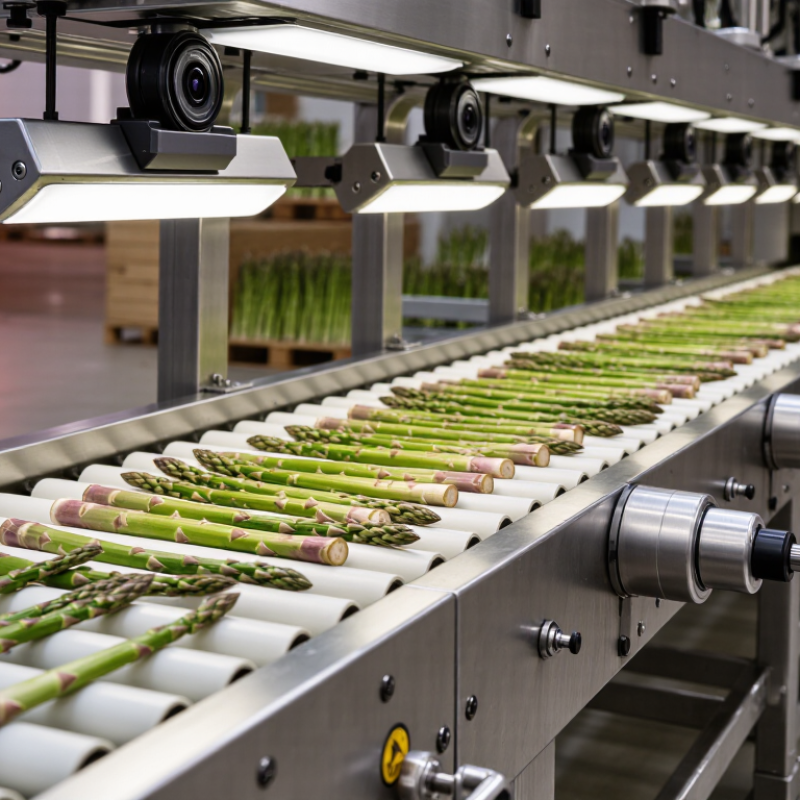
7 Tips for Choosing an Asparagus Optical Sorter

Define Sorting Goals and Asparagus Quality Requirements

Before choosing an asparagus optical sorter, define the sorting goal clearly. An optical sorter cannot correct an unclear grading plan. Decide whether the target is premium retail, processing, or mixed shipments. Each route needs different tolerance levels. Premium lots may require straight spears, tight tips, uniform color, and consistent diameter. Processing buyers may accept cosmetic variation but reject woody texture or excessive moisture. Write these differences as measurable rules.

Describe unacceptable defects using real samples. Include dark tips, open tips, bruising, soil, hollow stems, and foreign material. Record the acceptable diameter range, length, color bands, and defect size. Photos taken under working lights can support consistent evaluation. Use retained samples, not memory. A quality manager should compare human grading results with sorter trials. Test both fresh and stressed asparagus. Laboratory-perfect samples can mislead.

Set practical targets for detection accuracy, throughput, product loss, and changeover time. Ask how the machine handles borderline spears, not only obvious defects. Test wet surfaces, overlapping product, and mixed sizes. Harvest conditions change quickly. A fixed threshold may work today and fail after rain. That weakness matters. Require traceable test records and operator training before approval. The specification should remain measurable, but it should also allow careful revision.

Examine Optical Detection Technologies and Sorting Accuracy

Choosing an asparagus optical sorter starts with understanding its detection technology. Standard RGB cameras identify color differences, broken tips, and visible bruises under controlled lighting. Near-infrared sensors can reveal moisture changes and some internal defects. Hyperspectral systems inspect a wider range of wavelengths, but they usually require more calibration and technical support. Laser detection may help measure diameter and shape when stalks overlap.

Sorting accuracy depends on more than the camera. Light must remain stable across the inspection area. Dust, water droplets, and uneven conveyor surfaces can distort images. Ask for test results using asparagus from your own fields, not only polished samples. Measure good-product retention, defect removal, false rejects, and missed defects. These figures show whether the machine protects quality or simply removes too much produce.

Speed also changes accuracy. At high throughput, stalks may touch or rotate unexpectedly. A capable system should separate overlapping pieces and maintain consistent image capture. Check whether operators can adjust thresholds without losing traceability. Keep calibration records. They matter during seasonal changes.

In practical trials, I have found that a sorter may perform well in the morning but weaken after dirt builds on the lenses. That is an easy detail to miss. No system is perfect. Review rejected asparagus by hand, then refine the settings with measured evidence rather than guesswork.

Assess Product Handling, Throughput, and Crop Protection

7 Tips for Choosing an Asparagus Optical Sorter
Assess Product Handling, Throughput, and Crop Protection

A suitable sorter must protect asparagus before it improves quality. Tip one: inspect the infeed for drops, sharp transfers, and crowding. Bruised spears can deteriorate after packing. Tip two: measure real throughput, not the advertised belt speed. Record kilograms per hour during normal harvest conditions. Include wet, thin, and mixed-length asparagus. Tip three: request trials using your own crop. Clean samples can create false confidence. They rarely represent field variation.

Tip four: test detection against the defects listed in USDA Agricultural Marketing Service inspection instructions, including decay, discoloration, and mechanical damage. Tip five: compare acceptable-product recovery with reject accuracy. A sorter that removes defects but wastes premium spears needs adjustment. FAO’s State of Food and Agriculture 2019 estimated that 14% of food is lost between harvest and retail. Better separation can reduce avoidable losses, but only when handling remains gentle.

Tip six: check how cameras and software manage changing light, moisture, and spear orientation. Ask for calibration records and repeatability data. Tip seven: evaluate crop protection through drop-height measurements, belt speed, and reject-arm timing. Slow is not always safer. Excessive contact can still mark the surface. Review performance after several shifts, not one demonstration. The weak point may be upstream. That deserves honest reconsideration.

7 Tips for Choosing an Asparagus Optical Sorter

Key evaluation benchmarks for product handling, throughput, sorting performance, and crop protection.

Use these practical checkpoints when comparing optical sorters: confirm that the system handles the required asparagus diameter range, matches the planned line capacity, minimizes drop impact, and provides fast, consistent detection and rejection. Actual specifications should be validated with representative crop samples and production trials.

Verify Machine Configuration, Cleaning, and Operating Controls

7 Tips for Choosing an Asparagus Optical Sorter

Verify the machine configuration before judging its sorting performance. The feed system should handle different asparagus lengths without causing crowding. Check the belt width, camera position, lighting, and air-jet layout. These details affect how accurately the system detects spears, tips, discoloration, and foreign material. Ask for a live test using your own asparagus. Sample products reveal problems that showroom demonstrations may hide. Wet spears can reflect light differently. That matters.

Cleaning design deserves equal attention. Look for smooth food-contact surfaces, accessible covers, removable guards, and minimal hidden gaps. Operators should reach the inspection area without complicated tools. Moisture, soil, and plant residue can collect near the feed zone. If cleaning takes too long, it may be shortened during a busy shift. That is a practical risk. Review the sanitation procedure and observe one complete cleaning cycle. A machine can look clean while retaining residue under a conveyor edge.

Operating controls should be clear, responsive, and easy to adjust. Confirm that workers can change product recipes, sensitivity levels, belt speed, and reject timing safely. Password permissions can prevent accidental setting changes. Data logs also help compare performance across shifts. Do not rely only on automatic calibration. Operators should understand when to recalibrate cameras or inspect air pressure. I have found that small control misunderstandings can create large waste. The best choice is not always the most advanced model. It is the sorter your team can clean, verify, and operate consistently.

7 Tips for Choosing an Asparagus Optical Sorter - Verify Machine Configuration, Cleaning, and Operating Controls

Tip Selection Dimension What to Verify Practical Reference Data Acceptance Check
1 Product and defect profile Confirm that the sorter can identify the required quality defects, including discoloration, broken spears, foreign material, and abnormal shape. Use representative samples covering green, white, or purple asparagus; different diameters; wet and dry surfaces; and acceptable versus defective product. Run a blinded sample test with known defect counts. Record detection rate, false-reject rate, and product damage separately for each defect category.
2 Optical and mechanical configuration Check camera type, lighting arrangement, viewing angles, conveyor or roller design, feed width, and the number of sorting lanes. A suitable configuration should provide full visibility of the spear body and tip, stable product spacing, controlled speed, and sufficient resolution for the smallest defect that must be removed. Verify that no product is hidden, overlapped, or rotated into an uninspected position during normal throughput. Inspect both the top and side areas when shape or tip damage matters.
3 Capacity and product handling Compare rated capacity with actual line requirements, including peak harvest volumes, product density, and the size range being processed. Capacity should be evaluated in kilograms per hour or pieces per minute under the same product size, moisture, spacing, and quality settings expected in production. Test at normal and peak operating rates. Confirm that accuracy, gentle handling, and ejection timing remain stable without excessive bridging, bouncing, or product accumulation.
4 Cleaning and hygienic design Review food-contact materials, drainage, access panels, removable parts, cable protection, seals, and the cleaning method approved for the equipment. Common hygienic features include smooth accessible surfaces, corrosion-resistant construction, limited dirt traps, sloped areas for drainage, and components that can be removed without special tools. Request a documented cleaning procedure. Time the full cleaning cycle, check inaccessible areas with visual inspection, and confirm that electrical and optical components are protected according to the operating instructions.
5 Operating controls and recipe management Verify touchscreen usability, language options, user permissions, product recipes, alarm messages, speed control, and reject sensitivity adjustment. The control system should allow separate settings for product type, size, color, defect threshold, conveyor speed, and reject timing, while recording the active recipe and major changes. Ask an operator unfamiliar with the machine to load a recipe, change a permitted setting, respond to an alarm, and return to production without assistance.
6 Ejection accuracy and product protection Examine reject mechanism type, air pressure requirements, valve response, reject confirmation, and the separation between acceptable and rejected product. The ejection system should be synchronized with product position and should remove targeted spears without excessive impact, cross-contamination, or unnecessary loss of good product. Use a counted test batch and inspect both outlets. Calculate good-product carryover into rejects, defective-product carryover into the good stream, and visible bruising after sorting.
7 Maintenance, data, and validation support Check calibration procedures, spare parts, diagnostic tools, production data export, preventive maintenance intervals, training, and remote or on-site technical support. Useful records include throughput, reject counts, alarm history, recipe changes, inspection results, and cleaning or maintenance completion. Critical replacement parts should have defined lead times. Request a sample inspection report and a preventive-maintenance schedule. Confirm that operators can identify calibration drift and that quality personnel can verify performance using retained test samples.
Evaluation note: Compare all machines using the same asparagus varieties, size distribution, moisture condition, throughput, defect samples, and acceptance criteria. Performance data should be confirmed during a documented site test before purchase.

Compare Total Costs, Service Support, and Future Scalability

Choosing an asparagus optical sorter requires more than comparing purchase prices. Calculate the total cost across five years, including installation, air consumption, electricity, labor, maintenance, software updates, and rejected product. A cheaper machine may require more manual inspection or create higher product loss. Cheap is not cheap. Ask for measured results using asparagus from your own fields, sizes, moisture levels, and defect patterns. Laboratory demonstrations can look excellent, yet field conditions are less predictable.

Service support can protect production during short harvest windows.

Confirm response times, technician availability, spare-parts storage, training, and remote diagnostics before signing an agreement. Request a clear maintenance schedule and written coverage terms. In one equipment assessment, the overlooked cost was delayed support during a sensor failure. The machine itself was capable, but downtime affected several truckloads. That experience changed my evaluation checklist. Ask for service records or customer references, where possible.

Future scalability also deserves a practical test.

Check whether the sorter can add lanes, handle changing asparagus diameters, and connect with grading, packing, or production data systems. Modular upgrades may cost more initially, but they can reduce replacement risk later. Leave room. Estimate realistic volume growth, not optimistic sales forecasts. A useful question is simple: what must change when output doubles? If the answer involves replacing the entire system, the original saving may disappear. Compare documented performance, ownership costs, and support capacity together before choosing.

We Meet Our Clients Needs.

Meeting the diverse needs of our clients, we have complete machining facilities for everything from single part prototypes to large quantity production. Our small size is one of our biggest assets. It allows us to control costs and maintain the highest of standards.

Quality orientated  and delivery always on time or earlier than originally promised.

Strongly recommend MSD.